Space Security, The Next Frontier
The Chamber of Southern Arizona Hosts Industry Panel to Focus Upward
By Tom Leyde
Holding higher ground in warfare is a major advantage. Outer space is the ultimate higher ground, and maintaining security there is essential for keeping the United States safe.
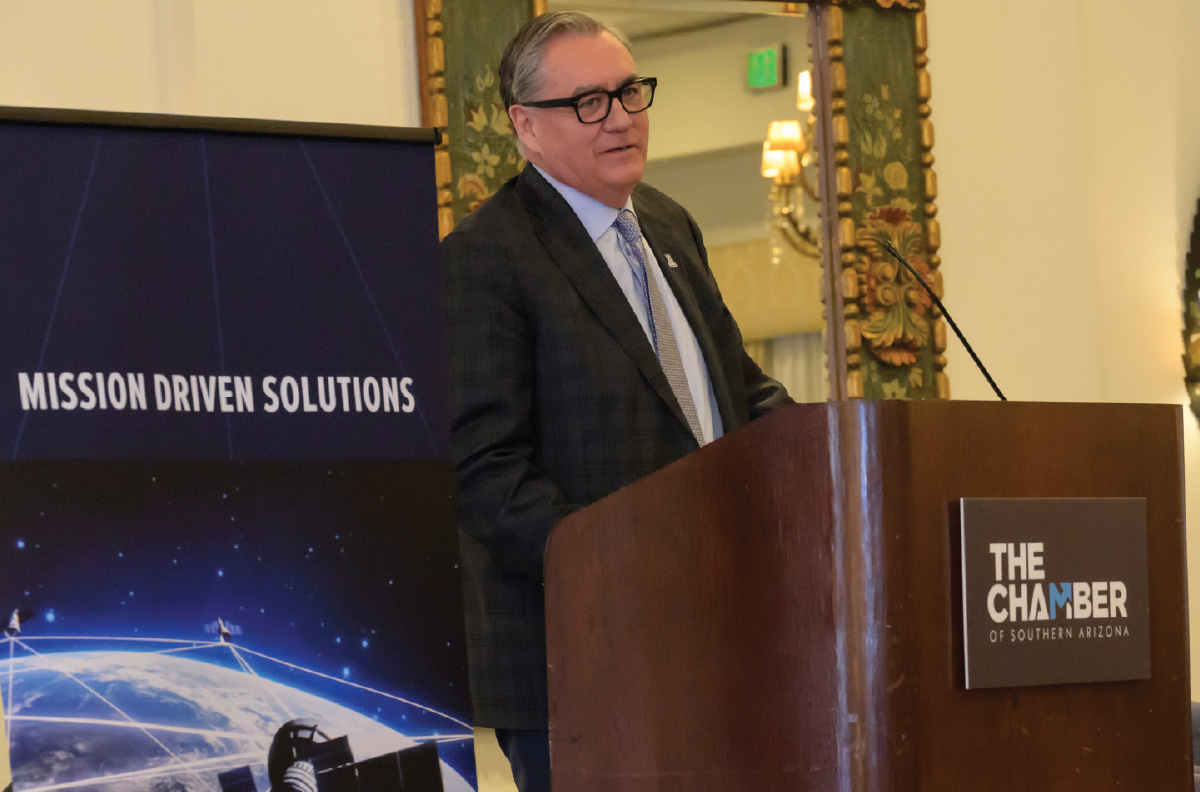
That, in a nutshell, was the message from four panelists speaking at an Industry Impact Series event presented April 21 by the University of Arizona, in conjunction with The Chamber of Southern Arizona held at the Arizona Inn.
Space has become the new arena for global power and technological dominance. As competition between nations increases space is essential to military readiness, secure communications, critical infrastructure and economic resilience.
“We live in a dangerous neighborhood, and we have to do everything we can … The world hasn’t been this dangerous since World War II,” said Tomás Díaz de la Rubia, UA senior VP for research and partnerships and panel moderator. He said the country needs to move quickly on the issue.
“We need industry. We need startup companies …,” said de la Rubia. “We’re going to be the home of the strongest academic institution in the nation supporting our war fighters in space.”
Outer space security involves the protection of activities and infrastructure, including satellites, space stations and future missions to the moon, Mars and beyond. As we rely more increasingly on space technology for communication, navigation and defense, it is critical that these systems are protected.
Panel members discussing the issue were:
• Erika Hamden, director of UA Space Institute and a 2026 Guggenheim Fellow
• Jim Cantrell, co-founder and CEO of Phantom Space Corporation
• Dan Geraci, president and CEO of Critical Infrastructure Investments
• Mark Spencer, Robert M. Edmund Endowed Chair of the James C. Wyant College of Optical Sciences at UofA.
Before recently joining UA, Spencer served as acting principal director for directed energy within the Office of the Under Secretary of Defense for Research and Engineering. In this role, he served as the senior official for directed energy within the U.S. Department of Defense.
The U.S. faces many threats these days, Spener said. He described directed energy as another arrow in the country’s quiver. Directed energy, he explained, turns a light beam into radio frequencies, microwaves or a laser beam than can be projected out of an antenna toward a threat.
While prototypes of the technology have been built, it hasn’t been delivered into the hands of the military.
“We need this technology,” Spencer said. “In the past, it has been overpromised and never delivered.”
He said the military needs to step up and demand the technology and outsource it. That, he said, is likely to happen soon, and that UA is ready to educate the next generation of scientists and engineers to develop and sustain it.
In order to create space security, Geraci said, there needs to be changes in the technology industry. Those changes include bringing small companies and capital together and educating scientists on how to run a business.
“Part of the problem,” he said, “is there are a lot of small (technology) companies and many people don’t even know they’re in Tucson. … We have all these technologies and no one really knows each other.”
Creating a bridge for those companies is the key to progress, he said. “Too many of these companies are like Hollywood movie sets when it comes to business. It’s great at the door but there’s nothing back there,” Geraci observed. “The problem is, we need to educate our scientists and engineers … about how to build successful businesses, and that is the gap that continues to be ignored.”
Phantom Space Corporation was started six years ago by Cantrell and three other individuals. Its goal is transforming the space industry from a highly expensive industry to an easily accessed arrangement.
“We are the Henry Ford of space,” he said. “Space for us is the new frontier.”
He imagines a time when anyone with a computer can put in a code and access data from space. The company is building a small, reusable launch vehicle to put data centers in space.’
“If we don’t have access to space, it’s like not having warships or aircraft,” he said.
Hamden noted that UA has been at the forefront of space science for decades. The university, she said, is training students to do critical technical jobs and integrating those students into the space industry.
The university needs input from space technology firms on how students can be better trained, she said.
Also, university scientists are perfecting ways to see faint objects, such as satellites orbiting the moon. “As more countries go to the moon,” she said, “it will become an issue. … We’ve got to make sure our astronauts are safe all the time and know what’s on the moon and who else is there.”
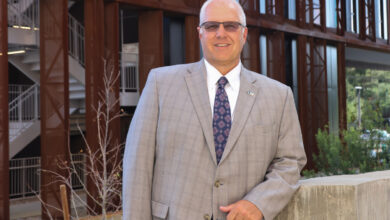
Pictured above – Tomás Díaz de la Rubia, Senior VP, University of Arizona Research & Partnerships. Photo courtesy University of Arizona Office of Research and Partnerships.