
Reaffirming its Presence
Raytheon Executive Speaks at Summit for The Chamber of Southern Arizona
By Tom Leyde
The state of Raytheon in Tucson is rock steady, with billions of dollars in defense contracts to fulfill and more employees needed to meet present and future production.
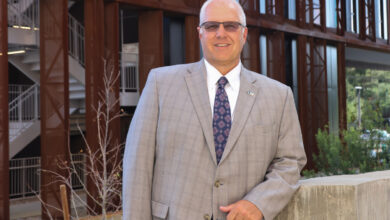
That was the message from Sam Deneke, president of Air & Space Defense Systems for Raytheon, an RTX business. Deneke was the keynote speaker Oct. 2 at The Chamber of Southern Arizona’s Business Summit & Expo at Casino Del Sol Resort.
“The future for Raytheon during its 70 years here is getting better and better,” said Joe Snell, Chamber president and CEO. “The importance that Raytheon has on the community is tremendous.”
Raytheon is the largest aerospace and defense company here as well as the largest missile manufacturing operation in the world, employing about 12,500 people in Tucson. Its key role in defense technology development, specializing in integrated air and missile defense, advanced sensors, space-based systems, hypersonics and effectors cannot be overstated.
“There have been lots of changes over the last six or seven years,” Deneke said.
In 2020, Raytheon became an RTX company with the merger of Raytheon with Collins Aerospace and Pratt & Whitney. That merger created a $7 billion-a-year business. Raytheon has 4.7 million square feet of space in Tucson, including its sprawling campus and its engineering office at the University of Arizona Tech Park.
This year, Raytheon landed its largest defense order − a $3.8 billion contract for the company’s advanced medium-range air-to-air missiles to be built for the U.S. Air Force, U.S. Navy and foreign military.
Raytheon will be building the fifth generation of the missile, and the contract will keep workers busy until 2031.
There are five parts that compose Raytheon’s operation, Deneke explained:
• Advanced products and solutions
• Advanced technology
• Aerospace defense systems
• Land and air defense systems
• Naval power
Evolving threats of war, Deneke said, underscore the importance of Raytheon. Those current threats, he said, include Ukraine, the Middle East and competition with China.
“China is evolving its defense faster than the U.S.,” he said. “It’s gotten a lot of people’s attention in the last decade or two.”
Defense systems begin with sensing, space and mission control, Deneke said. “Space is taking on a more prominent role these days, so it’s about sensing, transitioning and doing something about it.”
Deneke, who has spent most of his life in Tucson, also touched on Raytheon’s Nation Advanced Surface-to-Air Missile System – or NASAMS − which is designed to protect against a variety of aerial threats, including aircraft and drones.
NASAMS consists of the AN/MPQ-64 Sentinel radar, Kongsberg Defense & Aerospace’s Fire Distribution Center, launcher and Raytheon’s suite of effectors, including the AMRAAM missile, AMRAAM-ER missile and AIM-9X missile.
NASAMS provides air defenders with a tailorable, state-of-the-art defense system that can maximize their ability to acquire, engage and destroy current and evolving enemy fixed and rotary wing aircraft, drones and emerging cruise missile threats.
Raytheon, Deneke said, is also developing a new medium-range air and missile defense system for NASAMS called GhostEye radar.
NASAMS is operated by 13 countries. It has been integrated into the U.S. National Capital Region’s air defense system since 2005. Also, U.S., Norway, Finland, Spain, The Netherlands, Oman, Lithuania, Indonesia, Australia, Qatar, Hungary and an undisclosed country depend on NASAMS for homeland defense and the protection of critical assets.
The system meets all NATO requirements for interoperability.
Replenishment of munitions is a major priority for the U.S. and other nations at this time, Deneke said. “The U.S. government realized we do not have enough missiles. There is a huge surge in demand and it is the biggest issue in the Pentagon.”
He said Raytheon could land $10 billion in contracts by the end of 2025.
The company also keeps many other companies in business, with 500 suppliers in Arizona representing $2.5 billion in products.
“The company is all about people, and it is primarily an engineering company,” Deneke said. “It takes the entire spectrum of roles to make the system work.” He said Raytheon isn’t fully staffed and is always hiring in Tucson.
Raytheon, Deneke said, is fond of its relationships with the UA and Pima Community College, both of which help funnel talent to Raytheon. Manufacturing jobs, he said, are the hardest to fill and PCC helps fill those positions.
The company, Deneke said, works diligently within the Tucson community. “Last year, the company provided 40,000 hours of community service,” he said. “We are a member of the community and we are giving back because we are proud to be a member of the community of Southern Arizona.”
Another major challenge for Raytheon, Deneke said, is artificial intelligence. “The focus is the integration of AI to deal with big data, particularly to make the company more effective and efficient.”
He said the company must prepare for deceivers of its AI. These are entities or techniques that manipulate AI systems to produce false or misleading outputs. “It’s a big deal and it’s a big problem for us,” he said.
Pictured above – Sam Deneke, President, Air & Space Defense Systems, Raytheon, an RTX business. Photo courtesy Raytheon, an RTX business.