
Artificial Heart
Stock Offering Hopes to Fund Advances in Technology
By Dave Perry
For patients with end-stage heart failure, the SynCardia Total Artificial Heart is a second chance at life.
For Tucson-based SynCardia Systems Inc., which builds those hearts, funding from a public stock offering is a lifeline for the company, according to CEO Patrick NJ Schnegelsberg.
In September, SynCardia’s parent company, Picard Medical Inc., closed its initial public offering of 4.25 million shares of common stock at $4 per share. A subsequent, additional stock sale boosted gross proceeds to $19.5 million.
“It’s been a game-changer for us,” Schnegelsberg said. “We are now capitalized. We have the opportunity to really grow this business.”
Item 1 on the list of objectives for the funding is to retire debt, Schnegelsberg said. It now has “a squeaky-clean balance sheet,” he said. Next, is strengthening its marketing and outreach efforts to expand awareness and use of the SynCardia Total Artificial Heart.
“We’re still the only FDA-approved heart out there,” Schnegelsberg said, but not enough people know about it.
Most critically, “we’re financed to pursue our next step in the life of SynCardia, to develop a fully implantable version of the heart,” Schnegelsberg said.
That version, the Emperor, would have an internal motor pushing blood, rather than the external drivers used with the SynCardia Total Artificial Heart. The company hopes to have an Emperor beating inside a person sometime in 2028.
“The goal is to really have this as an alternative to a heart transplant,” Schnegelsberg said. “We want to make this fully implantable. We put the motor that powers the heart inside the patient.”
SynCardia, founded in Tucson in 2001 by Dr. Jack Copeland, Dr. Marvin Slepian and engineer Richard G. Smith, is “the only hard-core medical technology company in Tucson,” Schnegelsberg said. “We’re proud to represent this community on the global stage.” Only Smith remains part of the SynCardia operation.
It has built “a huge legacy” by producing a device that has kept more than 2,100 patients alive while awaiting heart transplantation.
There just aren’t enough hearts to go around. Each year in the U.S., 7,000 people are in acute need of a transplant. Annually, 4,200 actually get one.
“They’re the lucky ones,” Schnegelsberg said.
He believes the Emperor can change the equation. When it is approved, “you have the opportunity to save millions of lives” around the world, Schnegelsberg said. And it may open markets in nations where heart transplants are not performed for religious, ethical or cultural reasons.
Schnegelsberg, who became SynCardia’s CEO in 2023, analyzed the business with CFO Bernard Skaggs and COO Matt Schuster. “We realized, to make this baby fly, we need money,” Schnegelsberg said. They saw the IPO as the best path to capitalization. He had IPO experience.
“I forgot how hard it was,” he said of the offering. “There are always things that come up. In the end, it went as well as it could have.” Once finished, the team looked at one another and said “‘wow, we did it’.”
SynCardia’s 80 dedicated employees, people working in research and development, engineering, quality control, compliance, marketing and manufacturing, need to be paid.
“We want to make sure we can grow our revenues,” said Schnegelsberg, who believes SynCardia has had “an insufficient commercial focus. We’re all here to save lives, but we cannot save lives if we cannot run the company.”
SynCardia is creating a network of “several dozen centers of excellence,” hospitals and transplant centers with thorough understanding of the SynCardia Total Artificial Heart.
“We really want to build these centers who know what they’re doing,” Schnegelsberg said. “They can give much better patient outcomes, and everybody’s experience is going to be better across the board.”
SynCardia is working more closely with the nonprofit Unique Beating Hearts, an aggregation of SynCardia patients who can help providers and families “understand the patient side of the equation,” Schnegelsberg added.
“Families faced with end-stage heart disease are scared,” he said. “There’s nothing better than to speak to a patient who went through it. These are amazing stories.”
A “sizable number” of SynCardia’s patients “have used this heart for two years or more,” Schnegelsberg said, including one approaching an eight-year anniversary. Given those experiences, SynCardia is pursuing an FDA “long-term use” or “destination use” label for the SynCardia Total Artificial Heart.
The company is now trading under the ticker symbol “PMI” on the NYSE American exchange.
“It’s our shot. We have access to capital markets, we can develop the technology and really focus on bringing this fully implantable device to the market,” Schnegelsberg said.
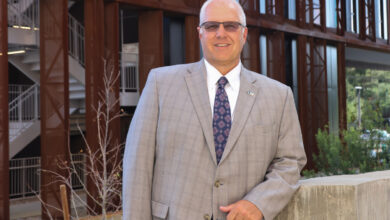
Pictured above – Patrick NJ Schnegelsberg, President & CEO, SynCardia Systems Inc. Photo courtesy SynCardia Systems Inc