
Arizona Photonics Days
A Spotlight of the Region’s Global Optics and Photonics Prominence
By Tyler McCusker
This year’s Arizona Photonics Days conference offered a veritable showcase for this region, long known as Optics Valley, as a global leader for innovation in optics and photonics.
More than 150 scientists, entrepreneurs, researchers and industry professionals from across the world gathered at the University of Arizona’s Grand Challenges Research Building on Jan. 14-16 to hear the latest developments and applications in these industries that power daily life.
Optics and photonics focus on the science and technology of light, forming the foundation of our phones, cars and hospital tools–from transmitting data to enabling precision manufacturing to driving next-generation computing.
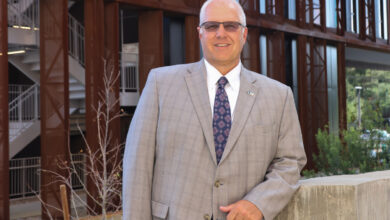
“We call ourselves an enabling technology. It underpins every aspect of modern life,” said Katie Schwertz, senior manager of optical assemblies and technology at Edmund Optics and chair of Optics Valley. The annual AZ Photonics Days offer “an opportunity to show what Tucson is doing on the global stage that matters,” she said.
Alana Gonzales, a doctoral student in UA’s Wyant College of Optical Sciences, presented her research on the development of an endoscopic imaging system for early detection of gastric cancer.
“Early cases of stomach cancer are frequently missed because the earliest signs are hard for any physician to spot with current screening methods,” Gonzales said. “Three-dimensional, sub-surface imaging of the stomach could allow doctors to catch signs of cancer earlier and give high-risk patients a better chance of survival.”
Dr. Arjun Dey of National Science Foundation’s NOIRLab is working on a Dark Energy Spectroscopic Instrument, a state-of-the-art astronomical spectrograph mounted at Kitt Peak National Observatory. It uses 5,000 robotic fiber optics to gather light from galaxies and quasars simultaneously.
This one-of-a-kind instrument aims to show scientists how our universe is expanding because of a mysterious – yet very real – force called dark energy.
“The universe never ceases to amaze and surprise us. By revealing the evolving textures of the fabric of our universe as never before, DESI [is] changing our very understanding of the future of our universe and nature itself,” said Dey in a recent interview with Space.com.
The 9th annual Arizona Photonics Days event, presented by Optics Valley and Arizona Technology Council, also provides industry leaders with trend discussions and networking opportunities. Tours of leading research facilities, such as the Nano Fabrication Center and Stewart Observatory’s Richard F. Caris Mirror Lab were also offered.
“How many things can you say Tucson is the best in the world at? We build the world’s largest mirrors. Period,” Schwertz said.
As chair of Optics Valley, Schwertz represents an industry cluster of more than 100 companies.
One of her goals is to make optics and photonics a little less insider-only in our city. Right now, UA is graduating many optical engineers from its degree programs, but the region lacks a local technician training program.
Optics Valley, the Southwest Center for Optics and Photonics, and local industry partners have recently teamed up with Pima Community College to offer new optics technician training courses, with the first of those launching at the end of April.
On May 17, the public will get a chance to delve into optical science themselves during the UNESCO International Day of Light Celebration. It’s a free, family-oriented optics and photonics celebration with hands-on activities, planetarium shows and talks about the applications of light at Flandrau Science Center.

CLICK FOR MORE INFORMATION
Photo courtesy Edmund Optics