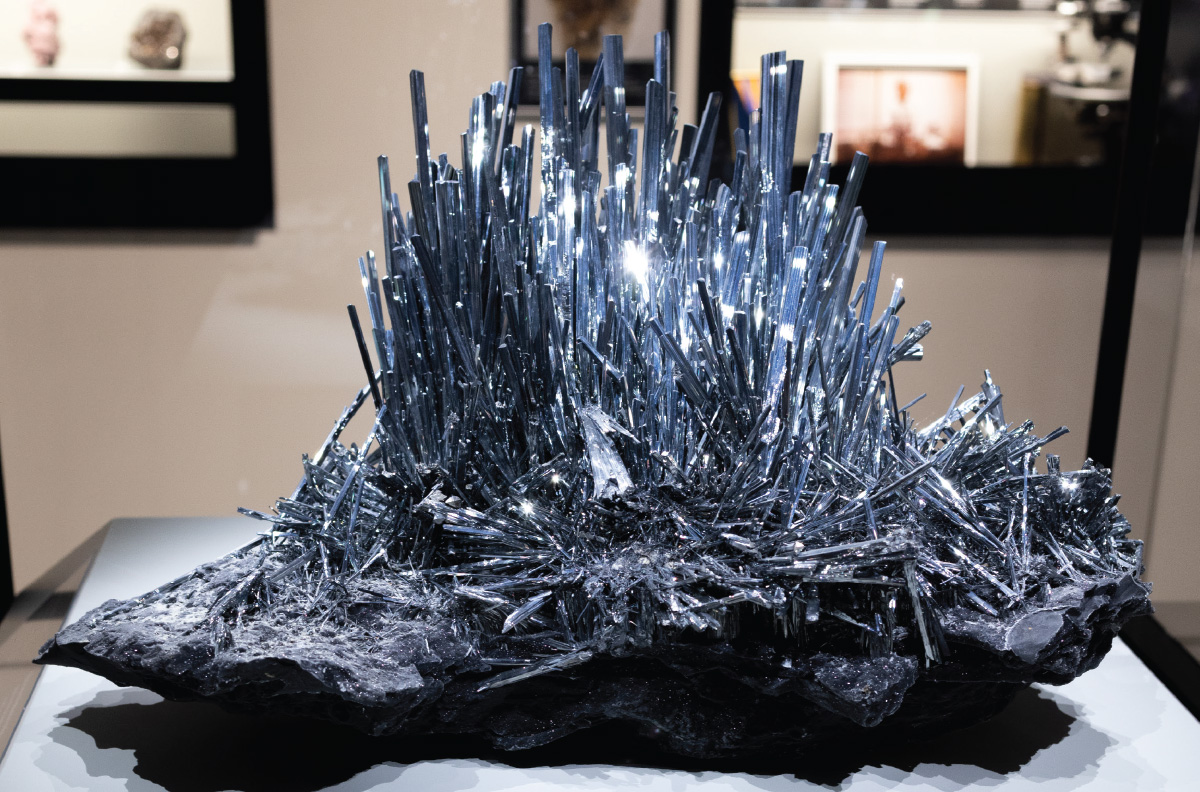
World’s Largest Gem Show
By Tiffany Kjos
It’s difficult to overstate the impact of the annual Tucson Gem, Mineral and Fossil Showcase, which brings Tucson tens of thousands of buyers and sellers—including more than 55,000 from outside the area—and generates millions of dollars in direct spending and tax revenue annually.
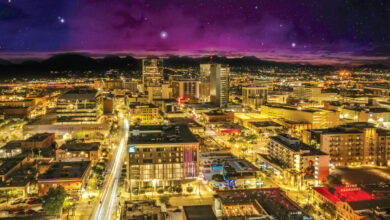
Downtown Tucson stages some of the showcase’s largest exhibitions.
The entire showcase, a collection of dozens of independently operated shows, spans four weeks from Jan. 27 through Feb. 14, 2027. It is the largest event of its kind in the world.
Once here, visitors spend money on lodging, attractions, dining and drinks, car rentals, gas, groceries, souvenirs and gifts, all adding up to tax dollars for the state and region and income for local businesses.
“You really can’t cast a wide enough net around the businesses that benefit from this annual Tucson event,” said Jane Roxbury, senior director of gem show and stakeholder engagement for Visit Tucson, the nonprofit organization that works to attract tourists, conferences, travel writers and others to the region.
The showcase is Tucson’s biggest tourism-related economic driver and continues to grow: A study of the 2025 event found that direct spending surged 118% since 2019, the year of the previous study, to more than $286 million, while city tax revenue rose 41% to $11.6 million.
The event’s growth, according to the report by the Seidman Research Institute at Arizona State University, “can be traced directly to the high level of customer service provided and effort put into continual improvement by the City of Tucson and Pima County in collaboration with Visit Tucson.”
That is where Roxbury comes in: She travels to shows such as France’s massive Mineral & Gem à Sainte-Marie-aux-Mines to create buzz and meet with the enthusiasts who make the showcase tick.
“Part of what I’m doing to grow the gem and mineral business here in Tucson is representing Tucson on the international stage—and it’s working,” Roxbury said. “I’ve spoken at the conference portion of their show. . .Our counterparts who operate that show give Visit Tucson a very large banner, the size of a chain-link fence, promoting our show and how exhibitors, especially those from outside the United States, can get ready to come to our shows.”
Started in 1955 as a single show staged by the Tucson Gem and Mineral Society, last year the showcase encompassed 56 shows at around 40 locations.
“The Tucson Gem, Mineral & Fossil Showcase is far more than an extraordinary economic engine for our community—it is one of Tucson’s most powerful global calling cards,” said Joe Snell, president and CEO of The Chamber of Southern Arizona.
“What makes the showcase especially valuable is the visibility it creates for Tucson. Every visitor who comes here experiences our community, our hospitality, our culture, our restaurants, our outdoor lifestyle and our business environment. They leave with a much deeper understanding of what Tucson and Southern Arizona have to offer.”
Downtown, the Tucson Gem and Mineral Show® is held at the Tucson Convention Center, with the Pueblo Gem and Mineral Showcase next door at the Ramada by Wyndham Tucson. The wholesale-only Gem and Jewelry Xchange (GJX) show occupies a 120,000-square-foot temporary structure west of the TCC, while the Tucson Gem Show on 22nd Street is a short hop from the city center.
Another must-see is the University of Arizona Alfie Norville Gem & Mineral Museum located in the Pima County Historic Courthouse at 115 N. Church Ave. In February, during the showcase, the museum hosts “A Day at the Alfie,” featuring free admission and public talks.
“The gem shows are stretching a little longer every year, but it’s about four weeks, and during those four weeks, if you’re in minerals and gems, Tucson is the center of the universe,” said Museum Director Violetta Wolf.
“We have people coming from all over the world—very famous gem artists from Germany, people from Japan—and I get to see them every year because they always come to Tucson. It’s this absolutely magical, crazy four weeks, and then the rest of the year we get to go back to being a nice, normal city.”
The museum welcomes 10,000 visitors a year, but its largest attendance is the month after the showcase, Wolf noted.
“We actually see a huge increase in March as well. I’d say everyone still has the gem show hangover, where they’re thinking, ‘I’m so excited about what I bought’ or ‘I want to learn more about this,’ so it’s really a very fun time for us.”
Photo by Brent G. Mathis
DOWNTOWN: CLICK TO READ ABOUT THE 12 ECONOMIC DRIVERS