Historic Theatres & Venues
Preserve Past, Propel Future Growth
By Tiffany Kjos
Downtown Tucson’s historic venues do more than herald the city’s past. Together, they bring hundreds of thousands of people downtown each year, filling restaurants, bars and hotels and driving an entertainment economy that continues to grow.
Chief amongst those performance spaces is the Fox Tucson Theatre, which is in the midst of a major project that is expected to bring even more people and spending downtown.
The Fox and Hughes Federal Credit Union this summer announced a $5 million multi-year naming-rights partnership for a 20,000-square-foot expansion of the theater, one of the largest corporate investments in the arts in Tucson history.
The timing fits: The credit union is nearly 75 years old, and the Fox will celebrate its centennial in 2030, when the Hughes Federal Credit Union Event Center at the Fox is expected to open.
“This is an investment in young minds and in the long-term vitality of the communities we serve,” said Andrew Britton, president and CEO of Hughes Federal Credit Union. “To lend our name to a space that will welcome more than 150,000 visitors a year, generate millions in regional economic impact, and bring STEAM and arts programming to Tucson’s youth is both a privilege and a lasting commitment to our city’s future.”
Elisa Ross, Hughes chief experience officer, agreed. “It’s two community cornerstones reaching historic milestones, investing in each other’s future in Tucson. We believe, and the Fox believes, that the arts belong to everyone. We’re proud to lead that effort.”
The expansion will add dedicated space for youth education and community programs, significantly extending the theater’s reach, Ross said. “A child’s ZIP code should never determine their access to the arts. This partnership helps change that.”
The Fox already generates an estimated $7.6 million a year in economic activity downtown, according to the Americans for the Arts Economic Impact Calculator. That is projected to reach $18 million a year after the Hughes Center at the Fox opens.
Theater patrons often grab dinner before or drinks after a show and perhaps stay in a hotel nearby, said Bonnie Schock, the theatre’s executive director.
“So the impact goes way, way beyond the theater. And it’s local,” she said. “If you start to look at the ripple effect that an anchor organization like the Fox has, it is extraordinary. This is why events-based economic development is so incredibly important. Because we continue every day, all year long, to be bringing people in.”
A Preservation Project
With 1,164 seats, the Fox, at 17 W. Congress St., hosts movies, concerts and other events 150 days a year that bring in 90,000 to 120,000 people. That number is expected to grow to 150,000 people after the adjacent building, a collection of suites at 1 W. Congress St. through 27 N. Stone Ave., is demolished and the new center is built.
“We view this very much as a preservation project. The Fox must continue to be moving forward into the future,” Schock said. “Our current space is simply not big enough for audiences. The pre-function space is simply not sufficient for the volume of people that we bring to the facility, not to mention that it’s not accessible. There’s no way for us to add an elevator, for example, in the existing facility.”
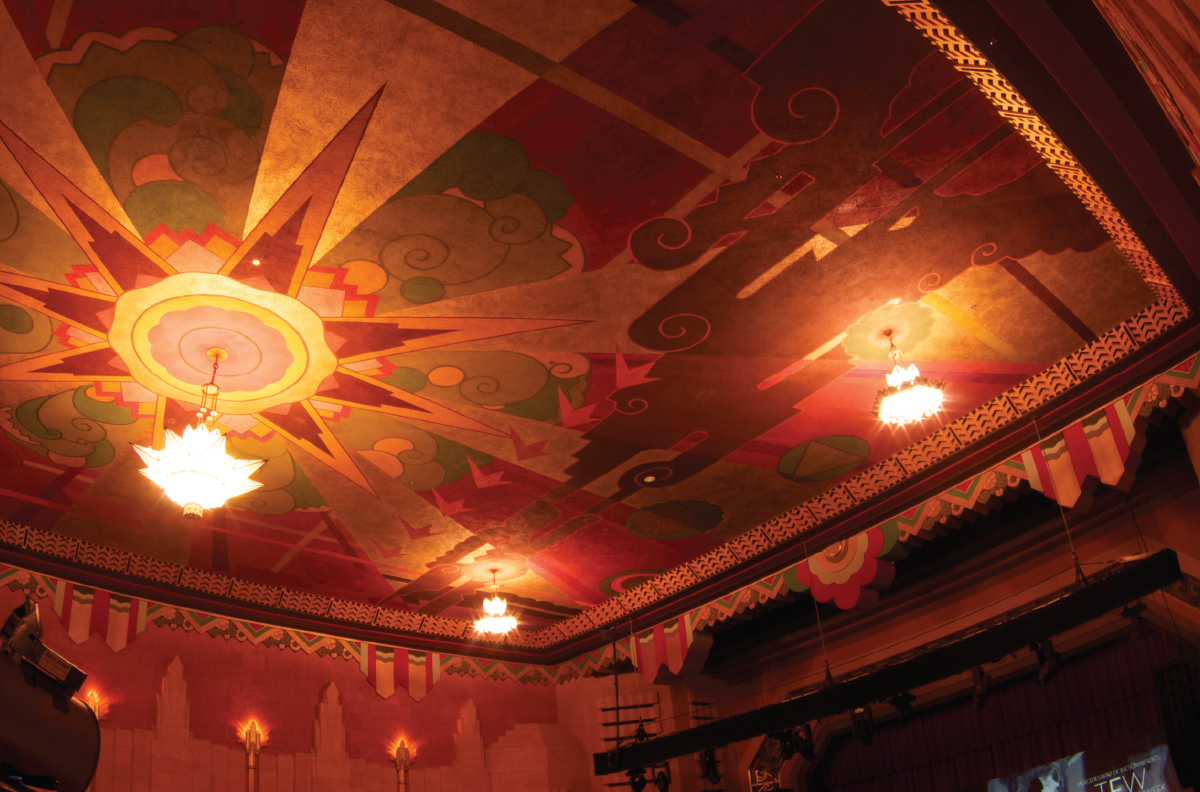
The new event center will have an entrance on Stone Avenue along with new public and service elevators and curbside drop-off that will make the Fox accessible for the first time ever. The theatre, opened in 1930 and on the National Register of Historic Places, will remain nearly untouched, but doors on both levels will connect it to the event center.
“The opportunity to build immediately next door, integrated with the historic facility, could not be more perfect,” Schock said.
The center will offer flexible event space, a second-floor performance venue with a 350-seat capacity, rooftop terrace, grand lobby and bar, catering kitchen and additional restrooms.
The $5 million contribution brings the Fox’s $26.6 million capital campaign to nearly its halfway point. Design is expected to go through the city approval process in 2027, with groundbreaking in 2028. The credit union also has issued a challenge for donors to contribute $100,000 or more by Dec. 31 to keep the project moving forward.
“Standing behind the Fox’s expansion reflects what our members believe: that every young person in Tucson deserves the opportunity to imagine, create, and thrive,” said Fabian Cordova, board chairman of Hughes Federal Credit Union.
Restoring Teatro Carmen
The Fox’s latest chapter follows a rescue effort led in part by Herb Stratford, who co-founded the Fox Tucson Theatre Foundation in 1999 to restore and reopen the theater in 2005.
Today, Stratford Art Works Inc., a nonprofit led by Stratford and his wife, Kerry, is rehabilitating Teatro Carmen, 380 S. Meyer Ave., in Barrio Viejo. Built as a showcase for Spanish and Latin American theater and opened in 1915, it is Tucson’s oldest performing arts venue.
The Tucson Jazz Festival, Tucson Symphony Orchestra and Ballet Tucson have all expressed interest in the space, which will accommodate 300 seated or 500 standing patrons.
Stratford Art Works has raised just under $6 million of the $9 million needed for the restoration, which began in 2021 and is expected to be complete in 2028. The theater will have an attached restaurant, and several other restaurants are within easy walking distance, so Stratford expects events at the theater to generate business throughout the historic neighborhood.
“All of a sudden you’re going to have events 300 days a year, and clearly that’s going to impact surrounding areas.”
A Different Kind of Stage
A few blocks away, amid cobblestones and tree-lined streets, the Temple of Music and Art offers a quieter atmosphere than some other venues. The Spanish Colonial Revival building at 330 S. Scott Ave. was built in 1927 and added to the National Register of Historic Places in 1976.
“There is a calming vibe here. I mean, the energy shifts depending on what event is occurring. But it’s an energy that can’t be bought. It can’t be built. It has to just sort of happen over time,” said Nick Cianciotto, director of operations and events.
The venue draws nearly 50,000 people each year and hosts about 175 events, ranging from Arizona Theatre Company productions to corporate gatherings, weddings and performances by community groups such as Ballet Tucson and the Reveille Men’s Chorus.
The temple, owned by the city and managed by Arizona Theatre Company, features a courtyard, lounge, rehearsal hall and the intimate Cabaret Theatre. Its 627-seat Alice Holsclaw Theatre offers audiences an up-close experience, Cianciotto said: “In my opinion, there is not a bad seat in the house.”
Jazz, History and Nightlife
Hotel Congress, 311 E. Congress St., has drawn downtown crowds since 1919. In 2022, it expanded its offerings with the Century Room, an 85-seat jazz club that hosts performances six nights a week and attracts 35,000 patrons annually.
The hotel opened in 1919 and is on the National Historic Register of Historic Places. The Century Room has its own entrance on the corner of North Fifth Avenue and East Congress Street, making it easily accessible, and retains much of the hotel’s historic properties, said Arthur Vint, a musician and former Tucsonan who worked at the famed Village Vanguard jazz club in New York City and returned here to help design the Century Room.
“It certainly has the feel that it belongs here,” he said. “When you come in, you’re coming through the original doors. Then we have a vestibule, which has 100-year-old swinging doors on it. So you definitely get a sense of history just upon walking in.”
Historic Neighbors
Across the street, the Rialto Theatre at 318 E. Congress St. hosts more than 200 shows a year, drawing more than 120,000 patrons. Depending on the show, fully a quarter to a third of audience members are from out of town, said marketing director Valerie Richarme. “We do typically get people from everywhere.”
The 926-seat venue, which can accommodate 1,300 standing patrons, hosts everything from Modest Mouse concerts to all-ages shows and rap artists, including Snoop Dogg.
The Rialto opened in 1920 after it was constructed by California-based William Curlett and Son, the same company that built Hotel Congress. Originally home to vaudeville shows, cartoons, silent films, newsreels and the occasional full-length film, it later became a Paramount Theatre, a furniture warehouse, a home for first-run Spanish-language films under the name El Cine Plaza and, for a couple of years, even a pornographic movie theater.
Most recently it became a partnership between the Rialto Theatre Foundation and the City of Tucson, which leased the building to the foundation in 2005 for 50 years.
With its art nouveau and “faux 18th century” décor, according to its National Register of Historic Places nomination, the theater was listed on the NRHP in 2003.
Recent improvements include installation of a new PA and sound system and replacement of the air conditioning, both with an eye toward preservation. Routine upgrades require far more care in a landmark facility, Richarme noted, explaining that a standard air conditioning replacement that normally takes weeks took five months because “literally everything is historic” and requires “a much gentler hand.”
Photo courtesy Fox Tucson Theatre
DOWNTOWN: CLICK TO READ ABOUT THE 12 ECONOMIC DRIVERS