Wildlife Rehab: Tucson Wildlife Center Marks 25 Years of Saving Injured Animals
By Dave Perry
Growing up in a wilder, less-populated Tucson, Lisa Bates rescued large, injured animals. Deer. Bobcats. Raptors.
Then her career called. Bates worked as a plant pathologist at the University of Arizona’s Environmental Research Lab.
“When I was able to retire, I wanted to keep active and do something I was passionate about,” Bates said. “This was the only inkling I had. I knew I wanted to rehabilitate wildlife.”
She and her husband, Pete Lininger, acquired 15 acres of land on far East Speedway, below the Rincons and along Tanque Verde Wash. They built a house and buildings, and started the Tucson Wildlife Center.
Now, 25 years later, Bates, her staff and volunteers have rescued, rehabilitated and returned tens of thousands of animals to the wild. It’s a rich legacy, certainly, but Bates, the executive director and a trained wildlife rehabilitator and nurse who doesn’t take a paycheck, is always in the moment.
Recently, Bates examined the X-ray of a skink on her phone, its tail accidentally fractured by a shovel blade. Could it be saved? One of the center’s seven volunteer, part-time veterinarians would make the call. Surgery would be performed at the center’s state-of-the-art Sam Goldman Wildlife Hospital, the only 24/7/365 animal hospital in Southern Arizona dedicated to the care of sick, injured and orphaned wildlife.
“If it can heal, it will be released,” Bates said. If not, it will be gently euthanized.
“We can rehabilitate anything that’s injured,” she added, noting that 80% are returned to their homes. “If they’re hurting and suffering and need help, we’re there.”
This work is “never boring,” Bates said. “Every day is something new.”
Every night, too. On another recent night, center staff rushed to stabilize an abandoned, newborn javelina, its umbilical cord attached. It was a life-or-death situation: if the newborn did not drink colostrum, that essential first mother’s milk, it would die. A herd was located, and the newborn was placed nearby.
“You don’t know if it really belongs to that herd,” said wildlife care specialist Kathy Carter McLin, who worked the rescue with supervisor Linda Smith and others. “We set it down, and they all came running, nine of them. The next thing, it was suckling. They slowly drifted off, and the baby went with them. Not a lot of people get to see that.We hugged, we high-fived, we were so excited.”
“There’s nothing better than the joy of a good, safe, happy release, back to his territory, back to their family,” Bates said.
From the start of 2022 through Oct. 17, the center rescued nearly 4,000 animals, among them hundreds of quail, doves and cottontails, along with bobcats, owls, javelina, bats, mice, skunks, ravens, raptors and more. There were 4,393 rescues in 2021 and 5,304 in 2020. Over time the center’s numbers have increased, in part because so many “backyard rehabilitators” are now closed. Nearly 20,000 phone calls a year come from across Southern Arizona.
The non-profit center, Arizona’s only rescue accredited by the Global Federation of Animal Sanctuaries, spends nearly $900,000 a year. It has 17 employees and dozens of volunteers. “We have a very capable staff,” Bates said. All funding comes from donations, grants and fund-raisers, such as the “Born to be Wild” benefit on Mar. 12 at the Westin La Paloma Resort & Spa.
“We know the Tucson community to be so involved and caring for our wildlife,” Bates said. “It’s really heartwarming to see that.” Her friend and artist Diana Madaras has helped greatly to raise awareness, and money. “You get enough of the negative in this life and world. We get to see the positive.”
“We couldn’t do it without” dozens of volunteers, said development coordinator Hubert Parker. More would be welcomed.
“We feel like we’re giving back to the wildlife community,” Parker said. “Without us, the animals would die. We’re not saving kids with cancer, but what we do is a reflection on the heart of this community. We feel like what we do is bigger than us.”
“I’m living out my passion, and having a reason to get up in the morning,” Bates said. Decades ago, “I knew I wanted to rehabilitate wildlife. That was just a kid’s dream. Somehow it played out, many years later.”
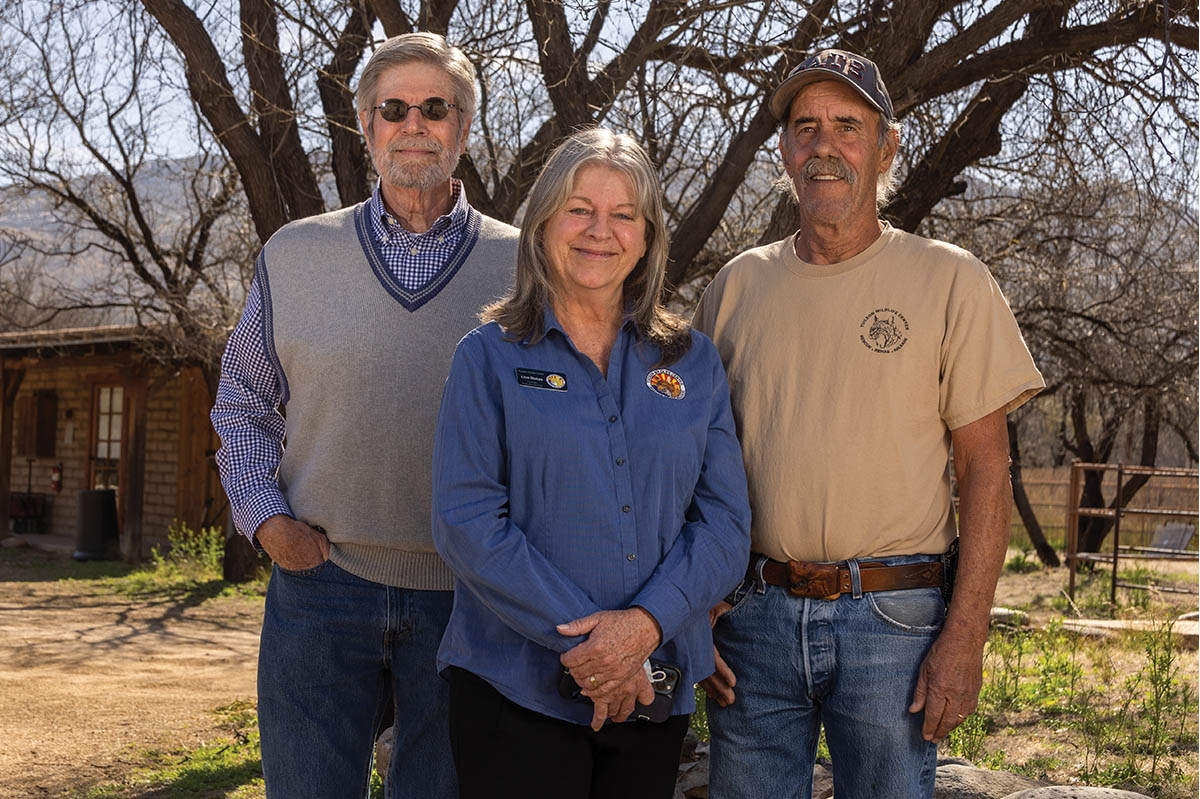
Pictured above from left – Hubert Parker, Development Coordinator, Tucson Wildlife Center; Lisa Bates & Pete Lininger, Owners, Tucson Wildlife Center. Photo by Brent G. Mathis