Raytheon Spirit of Education Award
Passion for Education
Sundt Honored with Raytheon Spirit of Education Award
By Eric Swedlund
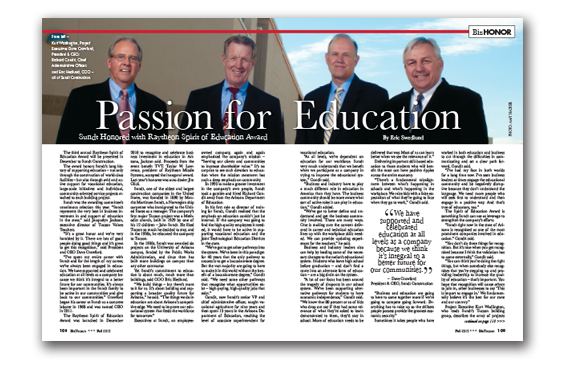
The third annual Raytheon Spirit of Education Award will be presented in December to Sundt Construction.
The award honors Sundt’s long history of supporting education – not only through the construction of world-class facilities – but also through avid and active support for vocational education, large-scale initiatives and individual, community-oriented service projects attached to each building project.
Sundt was the awarding committee’s unanimous selection this year. “Sundt represents the very best in business investment in and support of education in the state,” said Jacquelyn Jackson, executive director of Tucson Values Teachers.
“It’s a great honor and we’re very humbled by it. There are lots of good people doing good things and it’s great to get this recognition,” said President and CEO Dave Crawford.
“I’ve spent my entire career with Sundt and for the length of my career, we’ve always been engaged in education. We have supported and celebrated education at all levels as a company because we think it’s integral to a better future for our communities. It’s always been important in the Sundt family to be active in our communities and give back to our communities.” Crawford began his career at Sundt as a concrete laborer in 1968 and was named CEO in 2011.
The Raytheon Spirit of Education Award was launched in December 2010 to recognize and celebrate business investment in education in Arizona, Jackson said. Proceeds from the event benefit TVT. Taylor W. Lawrence, president of Raytheon Missile Systems, accepted the inaugural award. Last year’s honoree was auto dealer Jim Click.
Sundt, one of the oldest and largest construction companies in the United States, was founded in 1890 by Mauritz Martinsen Sundt, a Norwegian ship carpenter who immigrated to the United States as a teenager. The company’s first major Tucson project was a Methodist church, built in 1929 by one of his 12 children – John Sundt. He liked Tucson so much he decided to stay, and in the 1930s, he relocated the company to Tucson.
In the 1930s, Sundt was awarded six projects on the University of Arizona campus, funded by the Public Works Administration, and since then has built more buildings on campus than any other contractor.
Yet Sundt’s commitment to education is about much, much more than buildings, said COO Eric Hedlund.
“We build things – but there’s more to it for us. It’s about building and supporting a broader quality future for Arizona,” he said. “The things we do in education are about Arizona’s competitive edge. We need to improve our educational system that feeds the workforce for tomorrow.”
Executives at Sundt, an employee-owned company, again and again emphasized the company’s mission – “Serving our clients and communities to increase shareholder value.” It’s no surprise to see such devotion to education when the mission statement has such a deep emphasis on community.
In 1993 to make a greater investment in the company’s own people, Sundt took a gamble and hired Richard Condit away from the Arizona Department of Education.
In his first role as director of training for Sundt, Condit realized that the emphasis on education couldn’t just be internal. If the company was going to find the high-quality employees it needed, it would have to be active in supporting vocational education and the Joint Technological Education Districts in the state.
“We’ve got to get other pathways into the system. We’ve been in this paradigm for 40 years that the only pathway to success is to get a baccalaureate degree. But the vast majority are going to have to make it in this world without the benefit of a baccalaureate degree,” Condit said. “We need some other pathways that recognize what opportunities exist – high-paying, high-quality jobs that exist.”
Condit, now Sundt’s senior VP and chief administrative officer, taught vocational agriculture for nine years and then spent 13 years in the Arizona Department of Education, reaching the level of associate superintendent for vocational education.
“At all levels, we’re dependent on education for our workforce. Sundt very much understands that we benefit when we participate as a company in trying to improve the educational system,” Condit said.
“Business and industry have to play a much different role in education in America than they have. The business community should be more aware what sort of active roles it can play in education,” Condit added.
“We’ve got to better define and understand and get the business community involved. There are many ways. One is making sure the content delivered in career and technical education lines up with the workplace skills needed. We can provide updating experiences for the teachers,” he said.
Business and industry leaders also can help by leading some of the necessary changes to the nation’s educational system. Students who leave high school before graduation – and don’t find a route into an alternate form of education – are a big drain on the system.
“A lot of our focus has been around the tragedy of dropouts in our school system. We’ve been supporting alternative pathways for students to have economic independence,” Condit said. “We know that 80 percent or so of kids who drop out say if they had some relevance of what they’re asked to learn demonstrated to them, they’d stay in school. More of education needs to be delivered that way. Most of us can learn better when we see the relevance of it.”
Delivering important skill-based education to those students who will benefit the most can have positive ripples across the entire economy.
“There’s a fundamental misalignment between what’s happening in schools and what’s happening in the workplace. We raise kids with a false expectation of what they’re going to face when they go to work,” Condit said.
“Business and education are going to have to come together more if we’re going to compete going forward. Everything has to raise up so the skillsets people possess provide the greatest economic security.”
Sometimes it takes people who have worked in both education and business to cut through the difficulties in communicating and set a clear path forward, Condit said.
“I’ve had my foot in both worlds for a long time now. I’ve seen business leaders at times engage the educational community and be negatively disruptive because they don’t understand the language. We need more people who will seek first to understand and then engage in a positive way. And that’s true of educators, too.”
The Spirit of Education Award is something Sundt can use as leverage to strengthen the company’s efforts.
“Sundt right now in the state of Arizona is recognized as one of the most prominent companies involved in education.” Condit said.
“You don’t do these things for recognition. But it’s nice when you get recognized because I think the validation has to come externally,” Condit said.
“You can think you’re doing the right things, but when somebody else recognizes that you’re stepping up and providing leadership to increase the quality of education – that’s important. You hope that recognition will cause others to join in, other businesses to say ‘This is import to engage in.’ We fundamentally believe it’s the best for our state and our country.”
Project Executive Kurt Wadlington, who leads Sundt’s Tucson building group, describes the array of projects Sundt and its employees engage in locally to support education. An architect who practiced for 20 years before joining Sundt in 1999, Wadlington designed more than 30 elementary, middle and high schools – a work history that fuels his passion for education.
“I got to know educators pretty well and gained an appreciation for the challenges they faced and the dedication they gave to their job. As you evolve in your career, you just develop certain interests where you try to help where you can – and education has been it for me,” he said. “If you’re going to put your efforts toward a philanthropic cause, education is one that has an exponential benefit in terms of what it starts.”
One Sundt program, in collaboration with the UA’s College of Education, creates company internships, with a math and/or science component, for current teachers as they seek master’s degrees. During the summer months when they’re not teaching, they work as paid interns and gain additional skills.
“We have them perform job functions that have a connection to math or science. They create real-world examples to take back to the classroom to show how science and math apply to jobs,” Wadlington said. “It’s part of the whole experiential learning process. When a kid asks ‘What is math going to do for me?’ they have a real-life example.”
Sundt has also supported the University of Arizona BIO5 Institute’s Keep Engaging Youth in Science, the summer research internship program known as KEYS. Sundt helps underwrite the cost for high school students to work side-by-side with university researchers in world-class labs.
“It blew me away the complexity of the projects these kids are doing, learning real in-depth science,” Wadlington said. “Many of them have ambitions for when they go to college and this is a way for them to get exposure to it and get a jump on it.”
A number of activities capitalize on Sundt’s long relationship with the UA’s College of Engineering. Sundt sponsors projects for the school’s Engineering Day, in which students compete on real-world projects.
One Sundt program for younger students partners the company with TUSD’s John B. Wright Elementary School. A STEM-oriented school in a fairly disadvantaged neighborhood, Wright connected with Sundt on a courtyard redevelopment project. Sundt employees volunteered time to construct a courtyard that has learning components, including a garden.
“It’s not unusual for businesses to provide financial support, and we do that. But we try to do more than that,” Wadlington said. “It’s easy to write a check, but you can do more when you interact directly with students. That’s the key. Getting more involved makes more of a difference.”
Crawford said the company’s employees overall find it more enriching to engage personally and directly when it comes to education.
“We’re working on elementary schools, high schools, educational facilities at universities and community colleges. We get to talk to the educators because we’re so closely associated. It’s a little bit more tangible to us,” he said.
“Sometimes you want to donate money because that’s an answer, but other times you want it to be hands on. You want people to participate for the experience. People want to contribute with their hands and if they’re willing to contribute time and efforts, it’s more meaningful to them.”