To House, To Soar
The Power of Real Estate Summit Underscores Housing as Economic Driver
By Dave Perry
The future of real estate in this region is at once bright and cloudy.
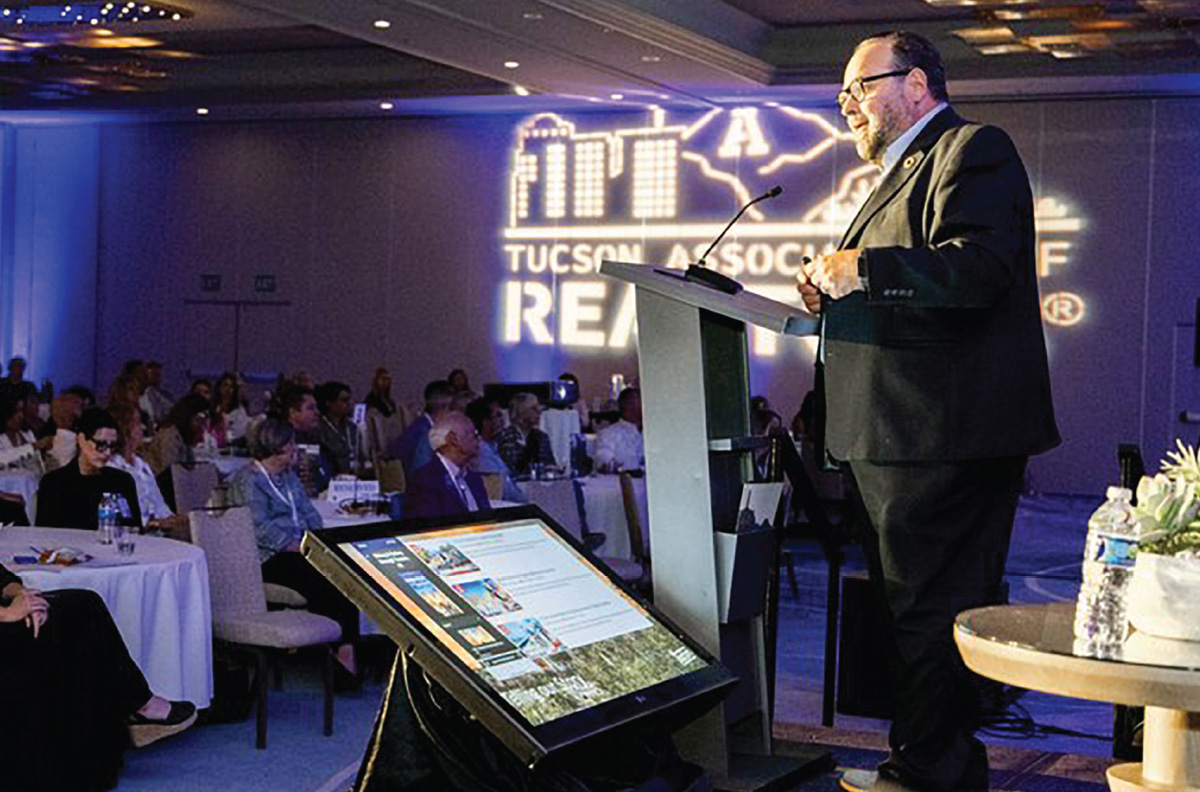
At The Power of Real Estate summit, held in March at the Westin La Paloma Resort & Spa, the optimism and realism were in equal share. Held by the Tucson Association of REALTORS®, this year’s gathering of industry professionals offered a look at the steps needed to succeed.
“Think of this as a look into the future of the Southern Arizona economy,” said TAR CEO Romeo Arrieta. “We really see opportunity here, but I worry that opportunity may be closing.”
Statewide, the real estate industry accounted for $121.1 billion of economic activity in 2025, representing 23.2% of gross state product. The economic impact of one home sale in Arizona is $144,700. Thousands of people work directly, and indirectly, in the real estate industry. Beyond agents, lenders, and workers in the trades, there are developers, inspectors, energy system installers, sign makers, insurers and photographers.
Arrieta, in his second year as TAR CEO, intends The Power of Real Estate gathering to be something more than “just another real estate event.” He has fallen in love with Tucson since coming here from the Marin, Calif., Association of REALTORS®, where the median price for a single-family residence north of San Francisco is $1.4 million.
Housing in greater Tucson is relatively affordable, but the region lacks an adequate, diversified supply, and a home “is still out of reach for too many Southern Arizonans,” Arrieta said. That’s a threat to the region’s ability to attract tomorrow’s high-wage employers, he argues.
Arrieta urges a shift in mindset. He believes the region and its leaders in the public and private sectors need to think of housing as economic infrastructure, a foundation upon which real, sustainable growth can build.
“Am I going to be able to house executives, manufacturing workers, and front-line workers?” he asked. “Do we have the infrastructure?”
“We have a desperate shortage of housing,” Mike Czechowski, senior project manager for City of Tucson economic initiatives, told The Power of Real Estate crowd.
Czechowski pointed out new retail commitments by Bass Pro Shops and Costco in Tucson, and the $1 billion, 1,000-job investment by American Battery Factory. And, he said, Tucson is working hard to lure suppliers and vendors within the booming Phoenix semiconductor business.
Where those workers will live is at the core of the challenge.
A December 2024 study conducted for the City of Tucson by Eco Northwest identified a 10-year need of 35,335 additional housing units in Pima County. The Common Sense Institute, which describes itself as a non-partisan research group, claims Arizona has an immediate housing deficit of “roughly 52,846 units” of all types, from single-family homes to apartments.
Danny Seiden, president and CEO of the Arizona Chamber of Commerce & Industry, said only 25% of Arizona workers can afford a two-bedroom home. “When workers can’t afford to live near their jobs, employers can’t recruit, families leave, and growth stalls,” he said.
Tucson and the nation have “an acute housing shortage for buyers earning under $75,000” a year, said Jessica Lautz, deputy chief economist and VP of research with the National Association of REALTORS®. “That’s a schoolteacher, that’s a first responder − people we need in our communities.”
At the end of 2025, the median price for an existing home in the Tucson market was $382,000, down 2% year over year. For a buyer to put down the traditional 20% to buy a home, that person or family needs to earn $92,000 a year to quality for financing, NAR’s Lautz said. Mortgage rates, and the rising costs of homeowners insurance, property taxes, and home maintenance, raise the hurdle.
“For our economy to be able to take off, we need a variety of housing,” Arrieta insisted. “Look at any thriving economy; they have variety. You can’t just generate the same thing over and over. We need to think about our front-line workers as much as our executives.”
Real estate is “very much a hyper-local industry,” Anthony Smith, chief economist for Realtor.com, told the TAR crowd. With 5.5 to 5.8 months of supply on the market, “Tucson is turning into a buyers’ market,” he said. “There is opportunity, and unrecognized potential, in Tucson.”
“We know there are headwinds,” Lautz said, “but there is a glimmer of hope.”
In Arrieta’s view, real estate is “where public policy meets the pavement. We’re trying to connect those dots. We’re roughly one-quarter of the economy. We need to work together.”
Pictured above – Felipe Garcia, president & CEO, Visit Tucson. Photo courtesy Tucson Association of REALTORS®